





Thrust I: Engineered EUV Source
Lasing wavelength of the coherent EUV sources recently demonstrated at the EUV ERC
Desktop Laser
at 10Hz
at 10Hz
Coherent HHG Light Near 13nm
Quasi-phase matching at 4nm and Harmonics from Ions (200-300 eV)
100nm


10nm

1nm

10eV

100eV
1keV
Lasing with 10Hz Table-top Pump
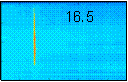
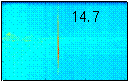
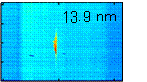
Essential to the success of the EUV ERC strategic plan is the development of compact and cost effective sources of coherent EUV light with significantly improved capabilities. Two complimentary approaches are being pursued: High Order Harmonic Generation and EUV Lasers.
| Operation Parameters of EVU Source | |
|---|---|
| High Harmonics Generation (HHG) | EUV lasers |
|
|
During the first year of the EUV ERC significant progress was made in decreasing the size of the coherent EUV light source testbeds, and in extending their operation to shorter wavelengths.
Demonstration of a gain-saturated table-top EUV laser at 10.9 nm [D. Alessi et al , Optics Letters, (2010)] |
 |
|---|---|
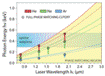
Demonstration of full phase matching spanning the water window (to 530 eV) using a compact source for the first time [M. Chen, submitted (2010)] |
|
Demonstration of 13.9nm table-top EUV laser with 20 microwatt average power [ D.Martz et al, submitted (2010)] |
 |
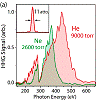
Generation of broad coherent bandwidths in the soft x-ray region supporting 10 attosecond pulse generation for the first time [M. Chen, submitted (2010)] |
 |
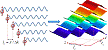
Development of a new spatio-temporal quasi phase matching scheme that allows spectral tuning of low-order harmonics [A. Bahabad, submitted (2010)] |
 |
Demonstration of the first all-diode-pumped EUV laser. [ F. Furch et al. Optics Letters, 34 , 3352, (2009)] |
 |
Experimental demonstration of full phase matching extending into the water window for the first time at 330 eV, using mi-infrared driving lasers . [T. Popmintchev et al, Optics Letters 33 , 2128, (2008); T . Popmintchev et al., PNAS 106 , 10516 (2009).] |
 |
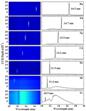
Demonstration of the first high repetition rate table-top lasers with wavelengths as short as 10.9 nm and gain-saturated output at wavelength as short as 13.2 nm. These lasers developed at CSU are the first short wavelength, highest average power compact EUV lasers demonstrated. [Y. Wang et al., Physical Review A 72 , 053807, (2005); D. Alessi et al., Optics Express 13 , 4050, (2008); M. Larotonda et al., IEEE J. Quant. Electronics 10 , 1363, (2005); B. Luther et al., IEEE J. Quant. Electronics 42 , 4, (2006); B. Luther et al., Optics Letters 30 , 165, (2005)] |
 |
Demonstration of partial phase matching in the water window at 4 nm for the first time (collaboration between CU and UC – Berkeley). [E. Gibson et al., Science 302 , 95, (2008); A. Paul et al., Nature 421 , 51, (2003); A. Paul et al., IEEE J. Quant. Electronics 42 , 14, (2006); E. Gibson et al., IEEE J. Quant. Electronics 10 , 1339, (2004)] |
  |
Demonstration of a desk-top size EUV laser operating a 46.9 nm pumped by a discharge at 12 Hz repetition rate (the highest repetition rate and smallest size of any EUV laser to date). [S. Heinbuch et al., Optics Express 13 , 4050, (2005)] |
 |
Demonstration of fully coherent beams at 13 nm by high harmonic generation (collaboration between CU, UC - Berkeley and CSU). [X. Zhang et al., Optics Letters 29 , 1357, (2004)] |
 |
Demonstration of high harmonic generation from ions , at photon energies greater than a factor of two higher than has been observed previously, in neon, argon, krypton and xenon (collaboration between CU and CSU). [D. Gaudiosi et al., Physical Review Letters 96 , 203001, (2006); B. Reagan et al., Physical Review A 76 , 013816, (2007); E. Gibson et al., Physical Review Letters 92 , 033001, (2004)] |
|
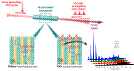
Demonstration of a new scheme for all-optical quasi phase matching , that increases the high harmonic yield at 70eV – 150 eV by > two orders of magnitude over and above what can otherwise be obtained. [O. Cohen et al., Physical Review Letters 99 , 053902, (2007); A. Lytle et al., Optics Letters 33 , 174, (2008); X. Zhang et al., Nature Physics 3 , 270, (2007); O. Cohen et al., Physical review Letters 98 , 043903, (2007); Z. Xiaoshi et al., New Journal of Physics 10 , 025021 (2008); A. Lytle et al., Physical Review Letters 98 , 123904, (2007); H. Kapteyn et al., Science 317 , 775, (2007)] |
 |
First demonstration of an essentially fully coherent gain-saturated EUV laser amplifier by injection seeding of a dense plasma-created ablating of a solid target. [Y. Wang et al., Physical Review Letters 97 , 123901, (2006)] |
 |
Demonstration of a new regime of harmonic generation, where isolated, sub-optical cycle EUV pulses are generated that are insensitive to the value of the carrier-envelope phase of the laser. This approach allows for selective control of the EUV energy and bandwidth. [ I. Thomann et al., submitted, (2008); A. Sandhu et al., Physical Review A 74 , 061803, (2006)] |
|
Complete characterization of a complex attosecond light field for the first time , by determining both the amplitude and phase. [I. Thomann et al., Phys. Rev. A 78 , 011806 (2008).] |
|
Theoretical new scheme with the potential for phase matched high harmonic generation at keV photon energies . This will require the use of a hybrid discharge/harmonic source. [O. Cohen et al., Physical Review Letters 99 , 053902, (2007); O. Cohen et al., Physical review Letters 98 , 043903, (2007)] |
|
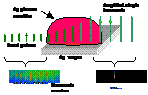
First demonstration of phase coherent EUV lasers in the 13 nm spectral region . Obtained by injection seeding of Ni-like Ag and Ni-like Cd plasma amplifications. [Y. Wang et al., Nature Photonics 2 , 94, (2008) ; F. Pedaci et al., Optics Letters 33 , 491, (2008)] |
 |
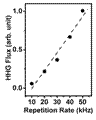
Demonstration of a spatially coherent , phase matched, high harmonic EUV light source at 50 kHz. [M. Chen et al., Optics Express 17 , 17376 (2009)] |
 |
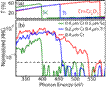
Generation of > 500 eV photons from multiply-ionized Argon ions for the first time . [P. Arpin et al., Physical Review Letters 103, 143901 (2009)] |
 |
| Observation of elliptically polarized high harmonic emission from molecules driven by linearly polarized laser light. [X. Zhou et al., Physical Review Letters 102 , 073902 (2009)] | 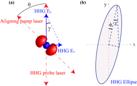 |
| Generation of isolated attosecond pulses, with a duration of ~200 attoseconds, using CEP unstabilized 15 fs multi-cycle driving pulses for the first time. This is a far simpler approach than has been implemented to date. [I. Thomann et al. Optics Express 17 , 4611 (2009)] | 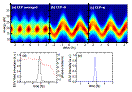 |
| Measured 80 asec EUV pulses with novel multilayer optics developed at UC – Berkeley achieving the shortest pulse known to date. [E. Goulielmakis et al., Science 20 ,1614 (2008)] . |  |
| First demonstration of a ~1 ps EUV laser pulses from a table-top plasma amplifier. These are the shortest laser pulses achieved to date from a table-top EUV laser source. [Y. Wang et al., Phys. Rev. A 79 , 023810, (2009)] . |  |
| Developed multilayer "quarter" wave plate mirrors to convert linearly polarized HHG pulses to circularly polarized fsec pulses. | |
For additional information see: University of Colorado at Boulder and Jorge Rocca's homepage